
TAX
How to prepare for a GRA tax audit
A GRA audit can feel very disruptive, but it is manageable if the company responds carefully from the start. This guide covers what the notice means, the records to assemble, the reconciliations to do before you explain anything, and the deadlines that apply if an assessment is served.
Who should read this
A GRA audit can feel very disruptive, but it is manageable if the company responds carefully from the start. How to prepare for a GRA audit comes down to three things: understand what GRA is asking for, organise the evidence, and protect the statutory deadlines without creating fresh problems through rushed or inconsistent answers.
This guide is for business owners, directors, finance managers and accountants who have received a Ghana Revenue Authority audit notice, information request or proposed adjustment.
Keep one point in mind from the start. If the audit ends in a proposed adjustment, GRA is proposing a change to your tax position. Nothing is payable at that stage, and your evidence and your reading of the law can still change the outcome.
Start with the notice
Do not start gathering files until you understand the notice. Read the letter carefully and confirm the taxpayer name, the tax types, the periods under review, the documents requested, the response date, and the officer or office handling the matter. If any part of the request is unclear, ask for clarification in writing before you send a large and unfocused set of documents. The next section shows what these papers look like.
Under the Revenue Administration Act, 2016 (Act 915), GRA has powers to request information, examine records and conduct audits. Section 36 deals with audits and requires the Commissioner-General to give advance written notice. Section 27 sets out your obligations in relation to maintaining documents, generally for at least six years from the relevant date and longer where a dispute, refund claim or investigation is unresolved.
An audit notice and an information request are not assessments, and neither asks you to pay anything. Each calls for a different response. You can only object once GRA has made a tax decision, which is why the objection route comes later in this guide. Treat an information request as if it were an assessment and you risk a defensive reply that does not answer what was asked.
Revenue Administration Act, 2016 (Act 915)
The Commissioner-General shall give an advance written notice to the person of an audit under this section.Section 36
What a GRA audit letter looks like
It helps to know what you are looking at. The papers below were issued by GRA in 2023 and are shown with the taxpayer's details removed. Your own letter may not look exactly like this, but the points to check are the same.
The introductory letter
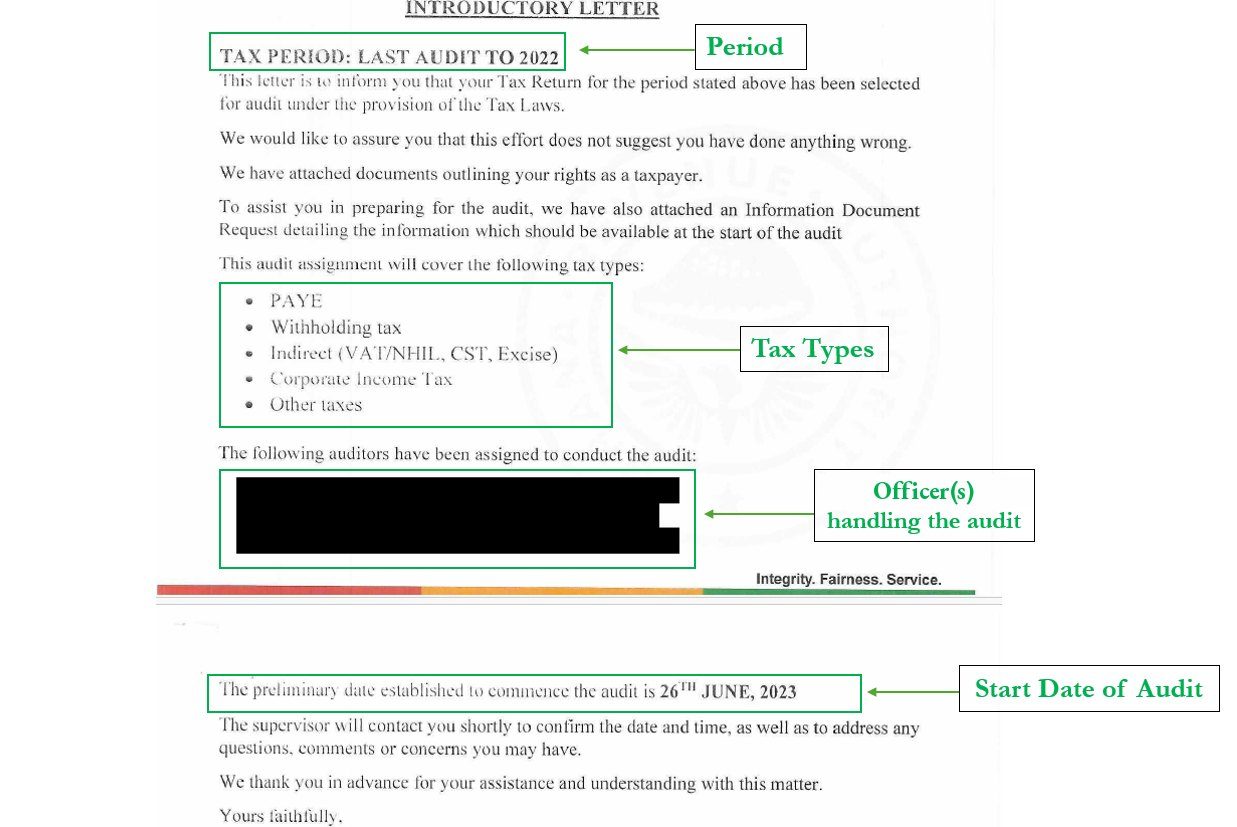
This is the letter that opens the audit. Four things on it matter before anything else.
- The period. Here it reads "last audit to 2022", so the audit runs from the end of the last audit up to 2022. That can cover several years.
- The tax types. This one covers PAYE, withholding tax, VAT and NHIL, CST, excise, corporate income tax and "other taxes". An audit this broad touches every reconciliation later in this guide.
- The officers assigned. These are the people you will deal with. Put their names in your request register.
- The start date. The letter calls it preliminary and says the supervisor will be in touch to confirm the date and time. If the date does not work for you, say so early and in writing.
Two other lines deserve a careful read. The letter says the audit "does not suggest you have done anything wrong", and it encloses a statement of your rights as a taxpayer. Read both.
The information document request
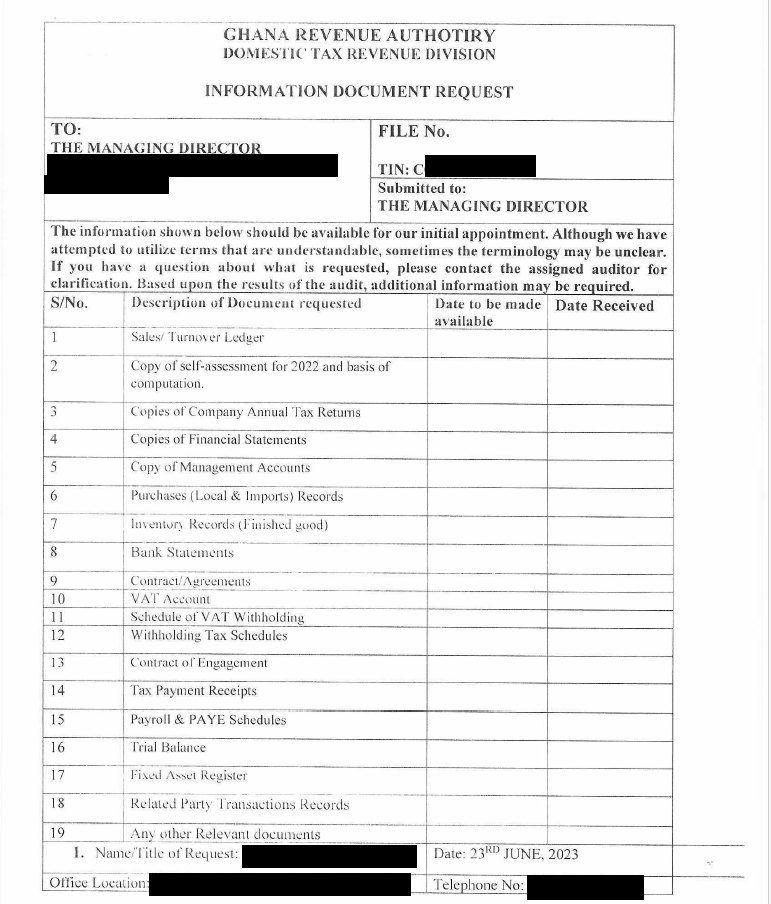
This came with the letter and sets out what GRA wants to see, nineteen items in this case. Three things about it are worth noting.
- It is dated 23 June 2023, three days before the preliminary start date. Start on it the day it arrives.
- The "Date to be made available" column is yours to fill in. Each date you enter is a commitment, so only put down dates you can keep.
- It says more may be asked for as the audit goes on. The list is where the audit starts, and further requests may follow.
It also asks for records that are easy to overlook, such as the fixed asset register, inventory records and records of related-party transactions, and they are on the list in the next section for that reason. The form invites you to contact the assigned auditor if any wording is unclear. Do that, in writing, before you send anything.
The power of attorney
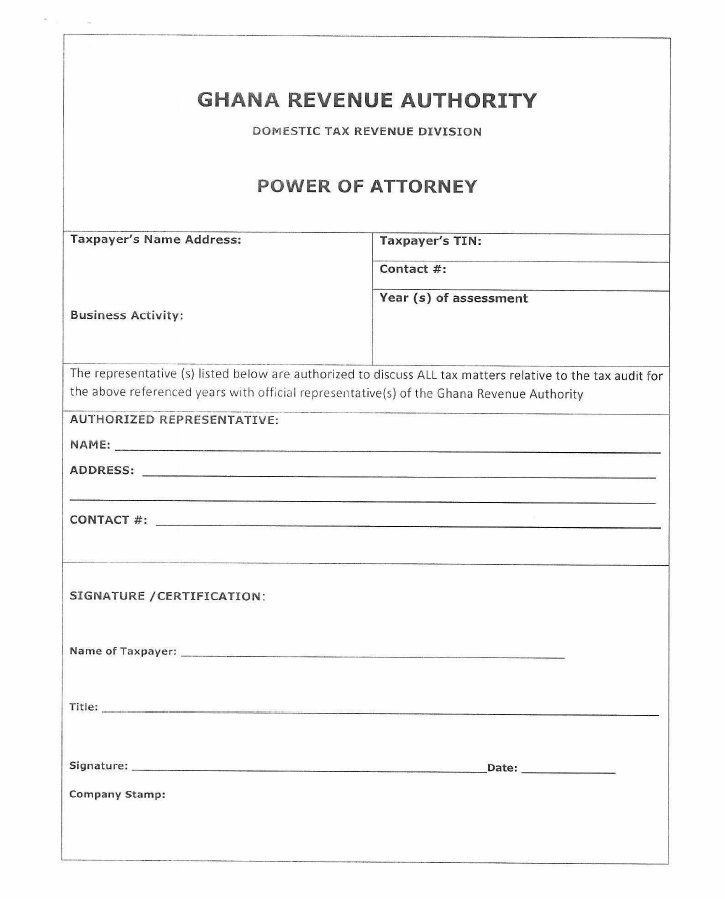
If someone else will deal with GRA for you, such as your tax adviser, this is the form that authorises them. It covers all tax matters relating to the audit for the years you list, so make sure those years match the period on the introductory letter. It is signed by the taxpayer and carries the company stamp.
Build a proper audit file
A good audit response is built from an organised file, not from scattered attachments. Create a request register showing each item requested by GRA, the person responsible, the due date, the document reference and the status. Keep copies of all submissions and acknowledgements. For sensitive records such as payroll, pension schedules and employee information, agree a secure transfer method and restrict internal access to the people who need to work on the response.
Assemble the following:
- The audit notice, attachments and earlier correspondence.
- Filed tax returns, payment receipts, acknowledgements and GRA account statements.
- Financial statements, management accounts, trial balances, general ledgers and tax computations.
- Bank reconciliations, sales records, purchase records, payroll records and withholding tax certificates.
- The fixed asset register, inventory records and records of related-party transactions.
- Contracts, invoices, proof of delivery, board approvals and other evidence supporting significant transactions.
- Records of previous assessments, objections, payment arrangements and unresolved credits.
We have built the request register as a template you can use rather than start from scratch. Download the GRA audit request register.
Reconcile before you explain
Before responding to GRA, reconcile the figures. Revenue per the accounts should be matched to the income tax and VAT returns. Purchases and expenses should be traced to the ledger, invoices, contracts and payments. Payroll should be reconciled to PAYE, SSNIT and any other relevant schedules. Withholding tax should be checked against supplier payments, certificates and monthly filings.
Do not rely on general statements such as "the figures agree" or "the expense was incurred for business purposes". Show the trail. If there is a timing difference, explain it. If there is an accounting adjustment, identify it. If there was an error in the return, quantify it and take advice on the proper correction route before making informal changes.
Answer each query directly
A good response takes GRA's queries one at a time. For each one, state the query, the company's position, the amount involved, the documents relied on and any point still outstanding.
If an expense is questioned, the bank payment on its own is rarely enough. Add the contract, invoice, approval, evidence of delivery and an explanation of the business purpose. If a foreign payment is involved, consider withholding tax, the treaty position, the source rules and the supporting documentation before responding.
Use one nominated contact for correspondence with GRA. Other staff can help gather information, but technical explanations should be reviewed before they are sent. Several employees giving different answers to the same question weakens the company's position and invites further queries.
What happens after you respond
Once the information is with GRA, the officers will generally review the documents, ask questions and then put forward a proposed adjustment. At this point GRA is proposing to amend your tax position, and nothing has been decided. Review the proposal carefully and respond with your own view, supported by the relevant law and documentation.
Until GRA raises an assessment, the position is open, and your evidence and your reading of the law can still change the outcome.
GRA officers are expected to explain the basis of a proposed adjustment and, where relevant, to provide the supporting material behind their work. They also have a mandate to educate the taxpayer, so you can ask questions and request an explanation of any adjustment you do not follow.
Bear in mind that revenue officers are there to collect revenue for the government, and the onus of showing that a different position is correct rests with the taxpayer. An officer's reading of the law does not settle the point. There may well be another provision that supports the company's treatment, and it is for the company to find it and put it forward.
Watch the deadlines
Take the response date in the audit notice seriously. If you need more time, ask for an extension promptly and give a realistic reason. Keep GRA's written reply, because a request for more time is not the same as approval.
If GRA issues an assessment and the company disagrees, the objection rules become urgent. Under Act 915 the route runs in three stages, each with its own time limit.
- Objection to the Commissioner-General, within 30 days. Section 42 requires an objection within 30 days of notification of the tax decision, stating the grounds. There is also an amount that must ordinarily be paid before the objection is admitted: for taxes other than import duties, all outstanding taxes including 30% of the tax in dispute. Import duties and taxes ordinarily require the full disputed amount. A new Customs Act received presidential assent in August 2026, but its commencement should be confirmed before you rely on it: official sources were still citing the Customs Act, 2015 (Act 891) in September 2026. Confirm which customs legislation applies to the specific duty. The Commissioner-General may waive, vary or suspend the admission requirement on written application. If you need more time to object, apply in writing before the 30 days run out; the Commissioner-General may extend the period where there are reasonable grounds (section 42(3) and (4)). A tax decision that is not objected to within 30 days is final (section 42(8)).
- The Commissioner-General's decision, within 60 days. Under section 43, the objection decision must be served within 60 days of receipt of the objection. The Commissioner-General may allow the objection in whole or in part, or disallow it. If it is allowed in whole, the assessment is amended and the matter ends there. If it is disallowed in whole or in part, the appeal route in the next step opens. If the 60 days pass with no decision, you may notify the Commissioner-General in writing that you elect to treat the objection as disallowed. Section 43 treats that decision as made 30 days after you file the election, so count the appeal deadline from that date, not from the day you file. An objection sitting unanswered is not a reason to wait indefinitely.
Do not simply wait for the 60 days to run out. Write to GRA every two or three weeks while the objection is open, ask where it stands, and keep every reply. Regular follow up keeps the file moving, and if no decision comes, it shows that the company pursued the matter properly. Staying silent for 60 days and then filing the election is the weaker position. If nobody in the business has the time to keep this up, following up with GRA on a client's behalf is routine work for a tax adviser.
- Appeal to the Independent Tax Appeals Board, within 30 days. Section 44, as amended by the Revenue Administration (Amendment) Act, 2020 (Act 1029), sends a first appeal against an objection decision that goes against you, in whole or in part, to the Independent Tax Appeals Board within 30 days of that decision, and a further appeal to the High Court within 30 days of the Board's decision. If you accept the Board's decision, the matter ends there. The Board comes before the court and cannot be skipped. Guidance that takes a taxpayer straight from the objection decision to the High Court predates this amendment. An appeal does not suspend the objection decision (section 45), so keep filing and paying current taxes while it runs.
Take advice immediately where an assessment, an objection deadline or a disputed admission payment is involved. Note also that the amount required to admit an objection is not the same as the amount ultimately due. Act 915, sections 42 to 44.
Where preparing for a GRA audit goes wrong
- Submitting draft accounts, final accounts and tax returns that do not reconcile.
- Sending documents without explaining what each document proves.
- Treating payment evidence as proof of deductibility or business purpose.
- Allowing different departments to respond separately without one reviewed company position.
- Leaving disagreements verbal instead of documenting the disputed amount, the legal issue and the evidence.
- Assuming that an informal discussion suspends an objection or appeal deadline.
When professional help is useful
Professional support is useful where the audit covers several years, the records are incomplete, related-party transactions are material, foreign payments are involved, or GRA has proposed an adjustment the company does not understand. It also matters where management must decide whether to agree, object, pay under protest, apply for a waiver or pursue an appeal.
Help is also worth having just for the follow up. Writing to GRA every couple of weeks and keeping the trail is routine work, but it matters, and it is the first thing to slip when a finance team is busy. GRA's power of attorney form, shown earlier in this guide, is what authorises an adviser to deal with the audit team on your behalf.
A tax adviser does not replace management's responsibility for the facts. The adviser adds value by testing the evidence, identifying the legal issue, quantifying the exposure and helping the company respond in a controlled way before deadlines are missed. Part of that value is knowing whether a different reading of the law is open to the company on the same facts, and whether the documents already on file are enough to support it.
Common questions about a GRA tax audit
Why has my company been selected for a GRA tax audit?
Act 915 gives the Commissioner-General a wide discretion to select taxpayers for audit, and the notice does not have to say why. Selection is not in itself an allegation of wrongdoing, and a clean filing history does not exempt a company. The sample letter in this guide says as much. Read the notice for what it does say: the tax types, the periods and the information requested tell you where GRA is looking.
How far back can GRA go?
Six years, but the six years does not always run from the same date. Under section 37 the power to make an original assessment expires six years from the date the Commissioner-General first became entitled to make it. For an adjusted assessment, section 37(5)(b) sets three different starting points: where a self-assessment is adjusted, six years from the due date for filing the return or, if later, the date it was actually filed; where any other original assessment is adjusted, six years from the date the notice of assessment was served on the taxpayer; and where an assessment that has already been adjusted is adjusted again, six years from whichever of those dates applied to the original assessment behind it. None of this applies where fraud, wilful default or serious omission is discovered, because section 37(4) lets the Commissioner-General assess at any time in those cases. This is also why section 27 requires records to be kept for at least six years.
Can I ask for more time to respond?
Yes. Ask in writing before the response date, give your reasons and a realistic delivery plan, and keep GRA's written reply. Sending a request is not the same as having an extension granted.
What documents will GRA ask for?
The information document request that comes with the introductory letter sets them out. In the example in this guide there are nineteen items, running from the sales ledger and bank statements to the fixed asset register and related-party records, and GRA says more may follow once the audit is under way. The request register keeps track of what has gone and what is still outstanding.
Is a proposed adjustment final?
No. It is a proposal to amend your tax position, and you can respond to it with the relevant law and documentation before it becomes an assessment. GRA officers are expected to explain the basis on which they arrived at it.
Do I have to pay before I can object?
In part. For taxes other than import duties, an objection is ordinarily admitted only once all outstanding taxes including 30% of the tax in dispute have been paid. Import duties and taxes ordinarily require the full disputed amount. A new Customs Act received presidential assent in August 2026, but its commencement should be confirmed before you rely on it: official sources were still citing the Customs Act, 2015 (Act 891) in September 2026. Confirm which customs legislation applies to the specific duty. The Commissioner-General may waive, vary or suspend the requirement on written application. The amount required to admit an objection is not the amount ultimately due.
What happens if GRA does not respond to my objection?
Do not wait out the 60 days in silence. Write to GRA every two or three weeks while the period runs, and keep every reply. Under section 43 the Commissioner-General must serve the objection decision within 60 days of receiving the objection. If that period passes with no decision, you may notify the Commissioner-General in writing that you elect to treat the objection as disallowed, which keeps the appeal route open. The decision is then treated as made 30 days after you file the election, and the 30-day appeal period runs from that date. Following up is what keeps the file moving, and it is the first thing to hand a tax adviser if the company has no time to chase.
Do I need a tax adviser for a GRA tax audit?
Not always. A single period with complete records and no contentious treatment can be handled in-house. It is worth getting help where the audit spans several years, the records are incomplete, related-party or foreign payments are material, or an assessment or objection deadline is in play. Management keeps responsibility for the facts either way.
Talk to us about your notice
If a GRA audit notice or a proposed adjustment is sitting on your desk, it helps to have someone read it properly before you start assembling documents. We will go through the notice with you, tell you what it actually covers, and set out what a controlled response looks like and what the deadlines are.
Book a call about your GRA audit notice. If it is urgent, say so when you write and we will treat it that way.
Important information
This guide states general information checked on 23 September 2026. Requirements and procedures depend on current law, regulator instructions and the particular facts. It is not legal, tax, investment or other professional advice.
Prepared by Elixir Audits, Chartered Accountants, and reviewed by Senyo Bissabah, Managing Partner.
Contact Us
Elixir Audits, Chartered Accountants
- Senyo Bissabah, Managing Partner: senyo@elixiraudits.com
- Worlanyo Bissabah, Advisory Partner: worlanyo@elixiraudits.com
- Michael Siaw Larbi, Partner, Tax and Advisory: msl@elixiraudits.com
- Gary Dewey, Advisory Partner: gary@elixiraudits.com
1 Alex Nkrumah Street, Airport West, Accra.
More in Guides

How to choose an audit firm in Ghana
Choosing an auditor starts with who is allowed to do the work: the licence, any sector registration and independence. Then it comes down to …
Changing Auditors in Ghana: Choosing an Audit Firm
Ghanaian companies must change their statutory auditor every six years under Act 992. What the rule requires, and how to choose your next audit …